In brief
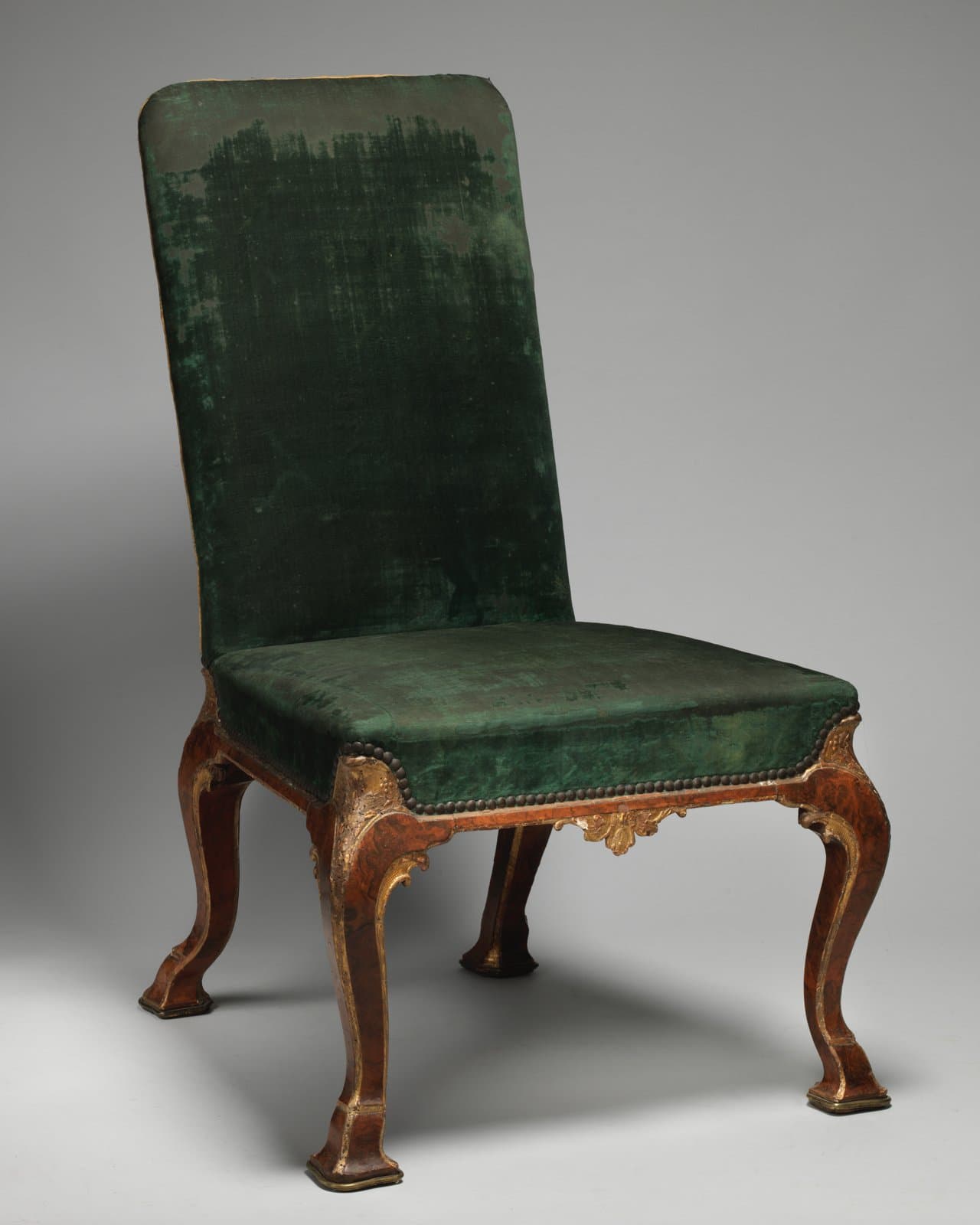
- This side chair, made about 1715, belongs to a large set of seat furniture supplied to Sir Robert Walpole for Houghton Hall, Norfolk.
- The set included two settees, a winged easy chair, stools and side chairs.
- The museum attributes it to Richard Roberts, who succeeded Thomas Roberts, carver and joiner to the royal household.
- It is one of a pair at The Metropolitan Museum of Art, New York, acquired in 1960.
From the archive is an occasional series in The Piece. Each one takes a single commission from a museum collection and asks the questions we put to working makers: who asked for it, what it was made from, and what the bench can still learn from it. The photographs are public domain, released by the museum for anyone to use.
The commission
Sir Robert Walpole (1676 to 1745), later the first Earl of Orford, ordered a large suite of seating for Houghton Hall, his house in Norfolk. Alongside side chairs like this one it included two settees, a winged easy chair and stools.
The attribution is indirect. The museum bases it on an account recording a considerable debt that Walpole owed in 1729 to a Thomas Roberts. Thomas Roberts, carver and joiner to the royal household, traded in London under the sign of The Royal Chair until he died in 1714. He was followed by Richard Roberts, presumably his son, who was working while Walpole was redecorating Houghton. The museum records Richard Roberts as active from 1714 to 1729.
Free, every fortnight
Get the next issue in your inbox
Technique, finished work, trade news and live jobs, for the bench and the studio.
Subscribe freeWhat it is made of
The museum describes the frame as beech and oak, veneered with burl walnut and partly gilded, and covered in silk velvet. It stands 106 cm high, 63.5 cm wide and 73.7 cm deep. The museum record does not say whether the velvet is the original cover.
What to look at
- The back: tall, fully upholstered and square-shouldered, with softly rounded top corners. The pile of the velvet is worn away in a broad band across the top and down one edge.
- The seat: stuffed to a firm, square edge and finished with a single row of close-set domed nails along the rail.
- The legs: cabriole, with figured walnut showing along their length and the edges picked out in gilt, ending in square pad feet.
- The carving: gilt shell and leaf ornament on the knees and at the centre of the front rail, kept small so the cover and the timber do the work.
For an upholsterer the chair is a lesson in how a cover ages. The pile has gone first across the top of the back and along one edge, and has lasted best in the middle of the panel. Whether or not this velvet is the first cover, it shows where a tall upholstered back takes its wear.
Sources
The Furniture Magazine
Every issue, free in your inbox
Technique, tools and materials, finished work worth studying, trade news and jobs — free to the bench and the studio.
Subscribe Free